3D printed brain cooling implant targets drug-resistant epilepsy
Researchers from the Leibniz Institute for Polymer Research Dresden, TUD Dresden, the University of Sheffield and the University of Limerick built a 10×10×3 mm 3D printed silicone implant that cools a small area of the brain's surface while recording its electrical activity. In rats it suppressed seizure-like activity, cutting delta-band signal energy by 48% at 18°C.
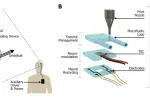
- The 10×10×3 mm implant is printed in DOWSIL SE1700 silicone on a RegenHU 3D Discovery printer
- In 37°C agar gel the system held its target within ±0.25°C and reached 23°C in about 5 seconds
- Cooling reaches 1–3 mm deep, comparable to the thickness of the human neocortex
- The external driver unit measures 17×8×5 cm and draws 2.6 W during steady cooling
Read next
Science