Stellar merger solves the Orion Nebula age paradox
Astronomers at Leiden University propose that θ1 Ori C1, the most massive star in Orion's Trapezium Cluster, formed from a merger of two binary systems. The event explains why protoplanetary disks and the M42 shell appear younger than the cluster's roughly 1-million-year-old stars.
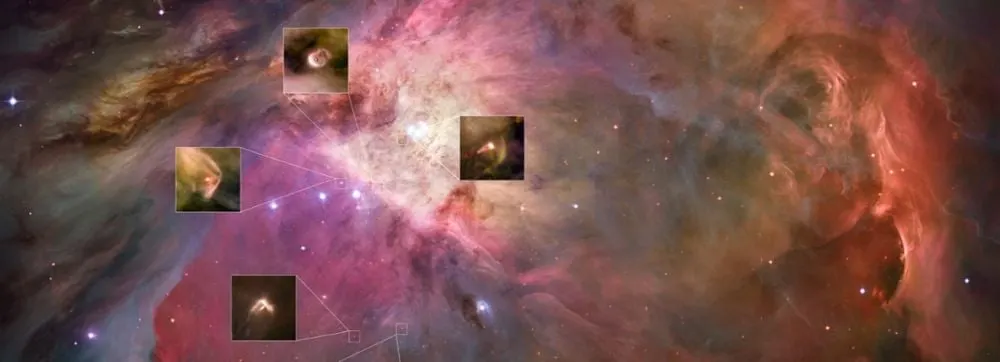
- θ1 Ori C1 exceeds 33 solar masses and provides most of Orion's illumination
- The M42 shell expands at ~13 km/s with a 2.5 pc radius, implying an age of ~0.3 million years
- The merger sharply boosted UV radiation and accelerated proplyd evaporation
- Cool evaporated gas supplied extra force to drive the shell's expansion
Read next
Science